Understanding Risk Assessment in AI Reports: A Practical Guide
Learn how to interpret AI-generated risk assessments in reports. Enhance clinical decisions with insights on accuracy, bias, and best practices.

Estimated reading time: 10 minutes
Key Takeaways
- AI risk assessments can assist in the diagnostic process by providing quantitative scores.
- Human oversight is essential to contextualize AI outputs and catch biases.
- Transparency in input data and algorithms can help boost trust and accuracy.
- Structured reviews and checklists help validate AI recommendations.
- Awareness of bias helps promote fair outcomes across diverse patient groups.
Table of Contents
- Background Information on AI Risk Assessment
- Key Concepts in Risk Assessment for AI Reports
- Interpreting AI-Generated Rash Reports
- Considerations for Accuracy & Bias
- Practical Tips & Best Practices
- Conclusion
- Call to Action
- FAQ
Section 1: Background Information on AI Risk Assessment
1.1 What Are AI-Generated Rash Reports?
AI-generated rash reports are automated analyses of dermatology images or patient data. They identify features such as:
- Asymmetry in lesion shape
- Color variation within a rash
- Border irregularities or diameter changes
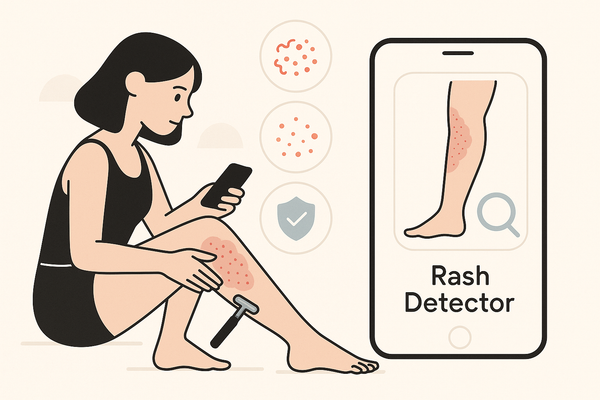
These reports can help detect patterns that may be subtle or difficult to identify visually by processing large numbers of images and metrics, potentially speeding up triage and supporting diagnosis. Some AI-powered apps, such as Rash Detector, utilize deep learning models trained on diverse, multi-ethnic datasets, which may improve their ability to recognize a broader range of skin conditions across different skin tones compared to earlier versions.
1.2 Defining Risk Assessment in AI Reports
Risk assessment evaluates:
- Likelihood (probability) of a clinical outcome, like malignancy
- Potential impact (severity) if the event occurs
It transforms raw model outputs into risk scores or categories (low, medium, high) for clinicians to consider. Some leading AI dermatology tools provide both a numeric risk estimate and a confidence interval or uncertainty measure, which can help users interpret the reliability of each prediction.
1.3 Traditional vs. AI-Generated Reports
Traditional reports rely on human-only review, which can be:
- Qualitative and text-heavy
- Slow, with potential backlogs
- Subject to inter-rater variability
AI-generated reports offer:
- Quantitative risk scores
- Rapid pattern recognition
- Consistent metrics
However, they still require expert context and oversight to ensure reliability. Increasingly, AI-generated reports are being integrated into electronic health records (EHRs), allowing comparison with previous findings and facilitating multidisciplinary review.
Section 2: Key Concepts in Risk Assessment for AI Reports
2.1 Fundamental Components
- Probability of risk: Numeric estimate (e.g., 0.78 equals 78% chance of a particular outcome).
- Magnitude of impact: Severity of the outcome (e.g., need for biopsy).
- Contextual factors: Image resolution, patient history, data completeness, and metadata on device type and lighting conditions, which are increasingly included in many AI apps.
2.2 Common Metrics, Algorithms & Methodologies
- Numerical risk scores: Percentages or 1–5 scales.
- Categorical labels: Low, moderate, high risk.
- Algorithms:
- Convolutional neural networks (CNNs) for image analysis.
- Transformer-based models, which have seen increased adoption for their ability to analyze both images and text.
- Decision trees or ensemble models for patient data.
- Methodologies:
- Pattern recognition against large clinical datasets.
- Rule-based frameworks like the ABCDE rule (Asymmetry, Border, Color, Diameter, Evolving).
- Federated learning, which allows model improvement using data from multiple clinics without sharing sensitive patient information.
2.3 Indicators of Elevated Risk
- Scores above predefined thresholds (e.g., >0.7 probability).
- Alerts for irregular or ambiguous features (e.g., spiculated borders).
- Automated advice for biopsy or specialist referral. Some apps now include explanations for risk flags, referencing specific image features or patient history factors.
Section 3: Interpreting AI-Generated Rash Reports
Step-by-Step Guide:
- Read the Summary Section
Identify the overall risk category (e.g., “high risk”) or numeric score. Look for both the risk estimate and the confidence interval (e.g., “78% risk, ±6%”) if provided. - Examine Input Data
Confirm which images and patient metrics the AI used (age, history, lesion size). Many apps now display a checklist of included/excluded data, and whether image quality passed automated checks. - Understand the Risk Score
Distinguish probability outputs (e.g., 0.85) from categorical labels and learn how thresholds map to labels (e.g., >0.8 = high risk). Some tools allow clinicians to adjust thresholds based on local practice. - Review Recommended Actions
Note follow-up suggestions such as imaging, biopsy, or specialist consult. Some AI systems may also suggest monitoring intervals or flag urgent findings with color-coded alerts. - Contextualize with Clinical Presentation
Cross-reference AI findings with exam results and patient history. If the AI highlights uncertainty or missing data, address these before making decisions.
Example with the Skin Analysis App:
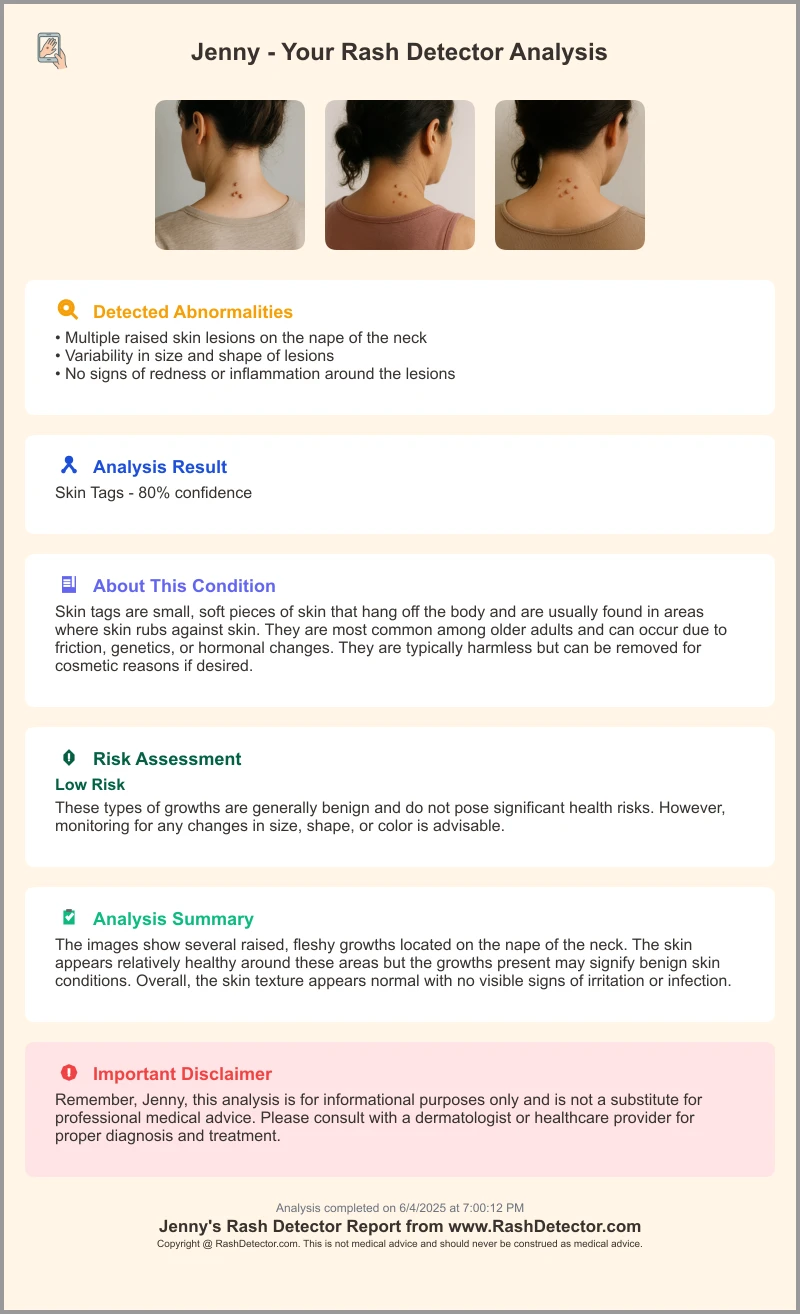
An AI report might show a 78% probability for a certain condition (such as “high risk”) highlighting asymmetry and irregular borders with a recommendation for dermatologist referral. Clinicians may:
- Order a biopsy.
- Correlate AI flags with hands-on exam.
- Decide on treatment based on combined insights.
For deeper insight on interpreting AI confidence scores, see interpreting rash diagnosis scores.
Important: AI-generated rash reports are for informational and educational purposes only. Always consult a doctor or dermatologist for a diagnosis and treatment plan, especially for rashes that are severe, spreading, painful, or persistent.
Section 4: Considerations for Accuracy & Bias
4.1 Potential Sources of Error and Bias
- Incomplete or low-quality inputs (blurry images, missing history).
- Algorithmic bias due to unbalanced training data (under-representation of certain skin tones). While some AI providers have expanded datasets, disparities can still occur, especially with rare conditions.
- Overreliance on quantitative scores without human insight.
4.2 Impact of Data Quality & Algorithmic Limitations
- Misclassification risks: benign lesions flagged as malignant, or vice versa.
- Importance of external validation with real-world clinical datasets. Some AI apps display validation statistics by skin type or age group, helping clinicians assess applicability.
4.3 Validation & Cross-Checking Tips
- Corroborate AI findings with expert human review.
- Review original images and data to ensure alignment.
- Use alternative models or comparative algorithms when possible. Some clinics may run two or more AI tools in parallel for challenging cases.
Section 5: Practical Tips & Best Practices
5.1 Treat AI as Decision-Support, Not Replacement
Adopt a human-in-the-loop approach for final decisions. Even with improvements in AI performance, clinician oversight remains crucial for patient safety.
5.2 Use Structured Checklists
A comprehensive checklist should cover:
- Image quality and clarity. Many apps now provide automated image quality scores or flag suboptimal photos.
- Completeness of patient demographics and history.
- Alignment of AI score with clinical signs and symptoms.
5.3 Key Review Questions
- “Is the AI risk score consistent with my clinical findings?”
- “Are there unexplained anomalies or missing data?”
- “Has a qualified professional reviewed this report?”
5.4 Further Resources
- NIST AI Risk Management Framework for deeper guidelines.
- Frontiers in Medicine article for advanced AI dermatology insights.
- Explore AI rash detector apps for practical tools.
Conclusion
Understanding risk assessment in AI reports can help clinicians make informed decisions in the clinic. By focusing on key metrics, recognizing limitations and biases, and keeping humans in the loop, you can use AI as a support tool. Applying these practical steps may boost diagnostic confidence and support better patient outcomes. Remember, AI-generated reports are not a substitute for professional medical advice or diagnosis.
Call to Action
Share your experiences or questions about interpreting AI-generated rash reports in the comments below. For more discussion, visit our IOSH forum discussion and join the community conversation.
FAQ
How accurate are AI-generated rash reports?
Accuracy depends on the quality of training data and validation processes. Some well-validated models may approach expert-level performance, especially with advances in multi-ethnic datasets and uncertainty estimation. However, human review is always required to confirm findings and ensure patient safety.
What if AI outputs conflict with clinical observations?
Prioritize clinical judgment and investigate discrepancies. Use AI as a second opinion—re-examine images, consult specialists, or use alternative models for comparison. If symptoms are severe, spreading, painful, or persistent, consult a dermatologist promptly.
Can AI replace dermatologists?
No. AI is designed to augment expertise, not replace it. It can assist with pattern recognition and risk scoring, but clinicians provide essential context, interpretation, and patient communication. Always consult a healthcare professional for diagnosis and treatment decisions.