Ensuring Fairness in Dermatology Algorithms: Investigating Bias and Strategies for Equitable AI Diagnosis
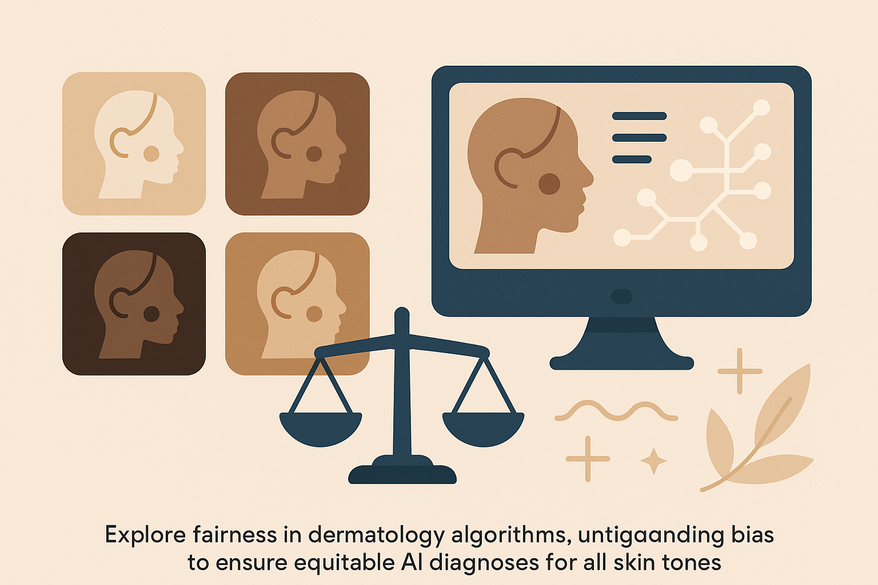
Explore fairness in dermatology algorithms, understanding and mitigating bias to ensure equitable AI diagnoses for all skin tones and demographics.

7 min read
Key Takeaways
- Bias can lurk at every stage: From data collection to model deployment, underrepresented skin tones often suffer higher misdiagnosis rates.
- Transparent evaluation using stratified accuracy and disparity measures is vital to spot inequities early.
- Equity-focused strategies—oversampling, fairness constraints, post-processing calibration—can reduce subgroup errors by up to 30%.
- Robust governance, continuous monitoring, and industry guidelines ensure long-term fairness.
- Collaboration among researchers, clinicians, regulators, and patient advocates will drive truly inclusive AI dermatology.
Table of Contents
- Section I: Understanding Fairness in Dermatology Algorithms
- Section II: Analyzing the Presence and Impact of Bias
- Section III: Investigative Evaluation of AI Dermatology Tools
- Section IV: Strategies for Achieving Fair Diagnosis
- Section V: Future Directions and Research Opportunities
- Conclusion
- FAQ
Section I: Understanding Fairness in Dermatology Algorithms
Fairness in dermatology algorithms means designing AI models whose predictions do not systematically disadvantage groups by race, age, gender, or skin tone. True equity requires:
- Equal diagnostic accuracy across demographic subgroups
- Prevention of disproportionate harm or missed diagnoses for underrepresented patients
- Transparent, objective criteria for training and evaluation
Key Components of Fairness
- Stratified accuracy: Measures model performance separately for each subgroup.
- Harm prevention: Tracks missed or false diagnoses in minority patients.
- Transparency: Documents data sources, annotation methods, and decision processes.
Potential Pitfalls
- Non-representative data: Training sets lacking darker skin tones skew results toward light skin.
- Implicit variables: Sensitive features (e.g., “ethnicity” metadata) may act as proxies for bias.
Role of Diverse Datasets
Robust fairness requires datasets covering the full spectrum of skin tones, ages, and genders. For practical guidance on inclusive training data and model design, see AI dermatology for diverse populations.
Section II: Analyzing the Presence and Impact of Bias
Fairness breaks down when biases in data and design slip through. Three common sources of bias are:
Data Collection Gaps
- Underrepresentation of darker skin tones leads to poor learning on those images.
- Geographic or socioeconomic sampling bias excludes rural or low-income patients.
Training and Validation Biases
- Labeling inconsistencies: Experts may annotate lesions differently based on skin color.
- Outcome definitions: Vague criteria for disease stages can embed subjective judgments.
Clinical Workflow Mismatches
- Different disease prevalence across groups changes optimal decision thresholds.
- Clinical protocols may not align with AI outputs, causing misreads in practice.
Case Studies
- Nature study: Models trained mostly on light-skin images misdiagnosed dark-skin cancers at rates 20–35% higher.
- PMC report: Minority subgroups showed a 25% increase in false negatives compared to white patients in melanoma detection.
Impact on Patient Outcomes
- Missed or delayed diagnoses lead to advanced disease and reduced survival.
- Reduced trust in AI tools deters patients from seeking tech-driven screening.
- Widened health disparities as under-screened groups face worse outcomes.
Section III: Investigative Evaluation of AI Dermatology Tools
To ensure fairness, we need metrics and methods that highlight disparities:
Performance Metrics for Fairness
- Stratified accuracy: Report sensitivity and specificity across skin tones.
- Disparity measures: Calculate false positive and false negative rates per subgroup.
- Calibration: Verify predicted probabilities match real outcomes across cohorts.
Methodologies to Detect and Quantify Bias
- Subgroup Performance Audits: Regularly test models on held-out samples for each demographic group.
- Fairness Metrics:
- Equalized Odds: Ensure equal error rates across groups.
- Demographic parity: Match positive prediction rates to group prevalence.
Real-World Tool Assessments
- Peer reviews reveal many commercial AI dermatology tools still underperform in darker skin.
- Success stories: Tools retrained with balanced datasets reduced false negatives in minority patients by 30%.
Section IV: Strategies for Achieving Fair Diagnosis
Implementing fairness requires a blend of data, model tweaks, and governance:
Data-Centric Approaches
- Oversampling/Re-weighting: Give underrepresented groups more weight during training.
- Curated Datasets: Build and share high-quality image banks covering all skin tones and ages.
Algorithmic Adjustments
- Pre-processing: Remove or mask sensitive features to prevent proxy bias.
- In-processing: Introduce fairness constraints (regularizers) that penalize unequal subgroup errors.
- Post-processing: Calibrate outputs per subgroup to align error rates.
Validation and Monitoring
- Continuous subgroup analysis throughout development and deployment.
- Equity dashboards: Real-time charts showing performance by skin tone, age, gender.
Industry Guidelines and Best Practices
- Coalition for Health AI principles: Promote transparency, robust evaluation, and equitable performance.
- Open reporting frameworks: Publish fairness audits alongside clinical results.
Section V: Future Directions and Research Opportunities
Fairness in dermatology algorithms is an evolving field. Key areas for progress include:
Research Gaps
- Large-scale Diverse Datasets: Expand repositories to include thousands of labeled images across all demographics.
- Standardization: Develop consensus on fairness definitions and shared benchmarks for healthcare AI.
Regulatory and Ethical Frameworks
- Mandated Fairness Reporting: Require ongoing equity audits for all deployed algorithms.
- Role of Oversight Bodies: Agencies should issue guidelines for bias testing and remediation.
Collaboration Models
- Multi-stakeholder Partnerships: Engage AI researchers, dermatologists, patient advocates, and policymakers.
- Public-Private Consortia: Share data and best practices in open platforms.
For an in-depth discussion, see bias in AI-driven skin analysis tools.
Conclusion
Fairness in dermatology algorithms is essential for clinical accuracy, patient safety, and health equity. By diversifying datasets, applying fairness-aware machine learning techniques, and adhering to transparent industry standards, we can reduce diagnostic disparities. We call on researchers, clinicians, and regulators to:
- Invest in large, representative image datasets
- Adopt rigorous bias detection and mitigation methods
- Mandate equity audits and transparent reporting
Together, we can build AI dermatology tools that serve every patient fairly—achieving truly equitable skin-care diagnostics for all.
FAQ
- How do dermatology algorithms become biased?
Bias arises from non-representative training data, inconsistent labeling, and clinical mismatches that affect underrepresented skin tones. - What metrics ensure fairness?
Key metrics include stratified accuracy, false positive/negative disparity rates, equalized odds, and calibration across subgroups. - Which strategies reduce subgroup errors?
Data oversampling, fairness constraints during training, and post-processing calibration have proven effective. - Who should enforce fairness standards?
Collaboration among AI researchers, dermatologists, regulators, and patient advocates—backed by industry guidelines and mandated audits—is critical.