Comprehensive Guide to Medication Rash Treatment: Identifying, Managing, and Preventing Medication-Induced Rashes
Learn medication rash treatment to identify, manage, and prevent medication-induced rashes effectively. Ensure quick intervention and stay safe.

Estimated reading time: 8 minutes
Key Takeaways
- Medication-induced rashes result from immune reactions to drugs, causing redness, bumps, and itching.
- Early recognition and prompt discontinuation of the offending agent can prevent progression to severe cutaneous adverse reactions.
- Severity-based treatment ranges from topical therapies for mild eruptions to hospitalization and high-dose steroids for SCARs.
- Preventive strategies, including detailed history, dose escalation, skin monitoring, and allergy testing, reduce future risks.
Table of Contents
- What Is a Medication-Induced Rash?
- Common Types of Medication-Induced Rashes
- Identifying Medication Rashes
- Risks and Complications
- Medication Rash Treatment
- Managing and Preventing Future Medication Rashes
- When to Consult a Healthcare Professional
- Conclusion
What Is a Medication-Induced Rash?
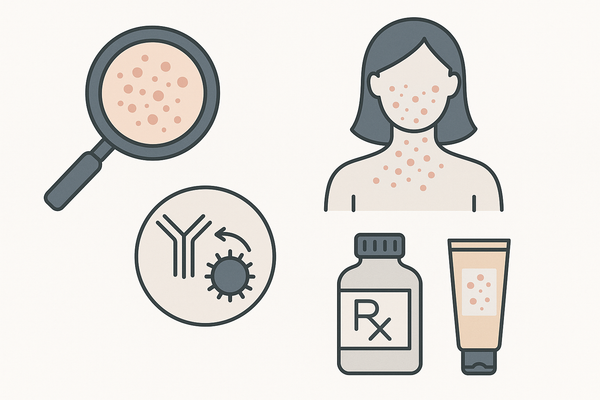
A medication-induced rash occurs when a drug triggers either an immediate Type I hypersensitivity or a delayed Type IV reaction. The immune system forms antigens, releases histamine, and causes vasodilation, leading to visible erythema, papules, plaques, or vesicles.
Timing of Onset:
- Immediate: minutes to hours (e.g., urticaria or hives)
- Delayed: 4–14 days, sometimes up to 3 weeks after starting a medication
Common Drug Culprits: penicillins, cephalosporins, sulfonamides, anticonvulsants (carbamazepine, phenytoin), NSAIDs, allopurinol, hydralazine, warfarin, bupropion, terbinafine, corticosteroids, diuretics.
Common Types of Medication-Induced Rashes
Recognizing the rash type guides management:
- Exanthematous (Maculopapular) Reactions: Red or pink macules and papules starting on the trunk.
- Urticaria, Angioedema, Anaphylaxis: Itchy wheals, deep swelling, potential progression requiring epinephrine.
- Fixed Drug Eruptions: Recurrent dark red/purple patches at the same site.
- Drug-Induced Vasculitis: Palpable purpura and blistering from vessel-wall inflammation.
- AGEP: Rapid pustules on erythematous base, often with fever.
- Serum Sickness–Like Reaction: Rash, arthralgia, fever without life threat.
- SCARs: Stevens–Johnson Syndrome, TEN, exfoliative dermatitis with mucocutaneous necrosis.
Identifying Medication Rashes
Early recognition depends on monitoring primary and secondary symptoms and urgent warning signs. For more on symptom patterns, see the detailed checklist.
- Primary Signs: redness, papules, hives, blisters, itching, scaling.
- Secondary Signs: fever, lymphadenopathy, joint pain, swelling.
- Urgent Warning Signs: dyspnea, tongue/throat swelling, mucosal blistering, rapid widespread rash.
Differentiating features include timing after drug initiation, trunk-first distribution, and rapid improvement upon discontinuation. Professional consultation with history, labs, and possible dermatology referral is essential.
Risks and Complications
Without prompt intervention, mild itching can escalate to systemic involvement, organ failure, and death in SCARs. Seek urgent care for breathing difficulty, facial swelling, high fever, or rash covering >10% of body surface area.
Medication Rash Treatment
A severity-based algorithm guides intervention:
1. Mild Rashes
- Discontinue suspected drug (physician approval)
- Cool compresses; fragrance-free moisturizers
- Topical hydrocortisone 1% or calamine lotion
- Oral antihistamines; acetaminophen or NSAIDs
- Resolution expected in 1–2 weeks
2. Moderate Rashes
- Prescription-strength topical corticosteroids
- Oral antihistamines or short-course systemic steroids
- Oral antibiotics if secondary infection occurs
3. Severe Rashes (SCARs)
- Hospitalization; discontinue offending agent
- High-dose systemic steroids; IV fluids; burn-unit–level care
- Specialist consults: dermatology, immunology, critical care
Accurate Diagnosis: Distinguish allergic vs. non-allergic vs. photosensitivity reactions to tailor therapy. For a comprehensive overview of how to identify, manage, and prevent medication-induced rashes, see our comprehensive guide to identifying, managing, and preventing drug-induced rashes.
Managing and Preventing Future Medication Rashes
Proactive strategies and thorough history improve long-term skin health. For a deeper dive into managing drug allergy rash, refer to our expert guide. You can also explore our complete guide to identifying, managing, and preventing drug-induced rashes for additional prevention tips and management strategies.
購入前に商品説明と利用条件を確認し、必要な追加準備がないか整理しておくことが大切です。サイズやセット内容を確認する場合は、刀剣乱舞 コスプレから候補を探せます。商品が届いたら内容を早めに確認し、必要な調整や追加準備を本番前に済ませましょう。
- Share a comprehensive drug and allergy history with your prescriber.
- Start new medications at the lowest effective dose; escalate slowly.
- Monitor skin daily; keep a symptom diary with photos.
- Use broad-spectrum SPF 30+ sunscreen on photosensitizing drugs.
- Consider allergy testing (patch, prick, intradermal, or blood tests) when appropriate.
When to Consult a Healthcare Professional
Call your doctor within 24 hours if a new rash appears after starting a drug, spreads after stopping it, or is accompanied by fever. Seek emergency care for respiratory distress, facial or throat swelling, extensive blistering, or high fever.
Conclusion
Early recognition, accurate identification, and severity-based management are the cornerstones of effective medication rash treatment. Preventive strategies—such as detailed patient history, prudent dosing, daily skin monitoring, and allergy testing—reduce future risks. Always seek professional guidance to confirm diagnoses, tailor therapies, and monitor potential complications.
FAQ
- What causes medication-induced rashes?
The immune system mistakenly recognizes a drug as foreign, leading to histamine release and skin inflammation. - How do I know if my rash is due to medication?
Look for timing after drug initiation, trunk-first spread, and improvement upon discontinuation. - When should I stop a medication due to a rash?
Contact your doctor immediately if you develop a rash with fever, swelling, or breathing difficulty. - Can medication rashes be prevented?
Yes—through dose escalation, daily skin monitoring, sunscreen use on photosensitizing drugs, and allergy testing. - Are all medication rashes allergic reactions?
No—some are non-allergic or photosensitive. Accurate diagnosis is essential for proper management.