Comprehensive Guide to Medication Rash Treatment
Learn how effective medication rash treatment can prevent mild reactions from developing into severe conditions like Stevens-Johnson syndrome.

Estimated reading time: 10 minutes
Key Takeaways
- Medication rashes result from adverse immune responses to drugs, affecting up to 3% of hospitalized patients.
- Early recognition and prompt intervention can prevent progression to severe conditions like Stevens-Johnson syndrome.
- Treatment ranges from OTC antihistamines and topical steroids to IV corticosteroids and epinephrine in severe cases.
- Maintaining a detailed medication log and communicating any reactions to your healthcare provider is critical.
Table of Contents
- 1. Recognizing Medication-Induced Rashes
- 2. Differentiating Rash Types & Mechanisms
- 3. Risk Factors & Common Triggers
- 4. Diagnosis & When to Seek Medical Help
- 5. Treatment Options & Management Strategies
- 6. Prevention & Future Considerations
- 7. FAQ
1. Recognizing Medication-Induced Rashes
Common Signs & Symptoms
- Hives (urticaria): Raised, itchy welts that migrate.
- Morbilliform eruptions: Red, measles-like macules and papules.
- Erythema and pruritus: General redness with intense itch.
- Scaly or exfoliative dermatitis: Widespread peeling or flaking.
Onset Timing
- Typically appears 4–14 days after starting a new antibiotic, anticonvulsant, or NSAID.
- Onset can be faster in patients with prior drug reactions.
Why It Matters
- Early recognition enables timely cessation of the offending drug.
- Delays can escalate a mild rash into life-threatening syndromes.
2. Differentiating Rash Types & Mechanisms
Allergic (IgE-Mediated)
- Mechanism: IgE antibodies trigger histamine release.
- Symptoms: Sudden hives, possible anaphylaxis (respiratory distress, throat swelling).
- Common Culprits: Penicillins, sulfa drugs.
Non-Allergic (Pseudoallergic or Dose-Dependent)
- Mechanism: Direct mast cell activation or metabolic byproducts.
- Symptoms: Delayed redness, acneiform eruptions, peeling skin.
- Common Culprits: High-dose corticosteroids, opioids.
| Type | Mechanism | Symptoms | Common Culprits |
|---|---|---|---|
| Allergic | IgE-mediated histamine release | Hives, itching, anaphylaxis | Penicillins, sulfa drugs |
| Non-Allergic | Direct cell activation or toxins | Acneiform eruptions, peeling | Corticosteroids, opioids |
3. Risk Factors & Common Triggers
Patient-Level Risk Factors
- Genetic markers: HLA-B*1502 linked to Stevens-Johnson in certain groups.
- Concurrent illnesses: HIV increases risk of severe reactions.
- History of allergies: Previous drug or food allergies heighten susceptibility.
- Age and gender: Older adults and women show higher incidence.
Medication Triggers by Class
- Antibiotics:
- Penicillins (e.g., amoxicillin 500 mg TID)
- Sulfonamides (trimethoprim-sulfamethoxazole)
- Anticonvulsants:
- Phenytoin (100 mg TID)
- Carbamazepine (200 mg BID)
- NSAIDs:
- Ibuprofen (400–800 mg every 6–8 h)
- Naproxen (250–500 mg BID)
- Isoniazid & Barbiturates: High-dose regimens in TB or seizure control.
4. Diagnosis & When to Seek Medical Help
Self-Assessment Guidelines
- Track timing: Note drug start dates and rash appearance.
- Photograph daily: Monitor changes in size, color, spread.
- Record itch level: Rate 1–10 each morning and evening.
- Maintain a medication log: Include names, doses, start dates.
Professional Work-up
- History & Physical: Physician reviews your log and examines the rash.
- Skin Biopsy: For severe or unclear presentations.
- Blood Tests: CBC with eosinophil count to assess for DRESS.
Red-Flag Symptoms Requiring ER
- Anaphylaxis: Facial/throat swelling, wheezing, hypotension; treat with epinephrine 0.3–0.5 mg IM.
- SJS/TEN: Blistering/peeling over >10% body surface; mucosal involvement.
- DRESS Syndrome: Fever >38 °C, lymphadenopathy, liver or kidney dysfunction.
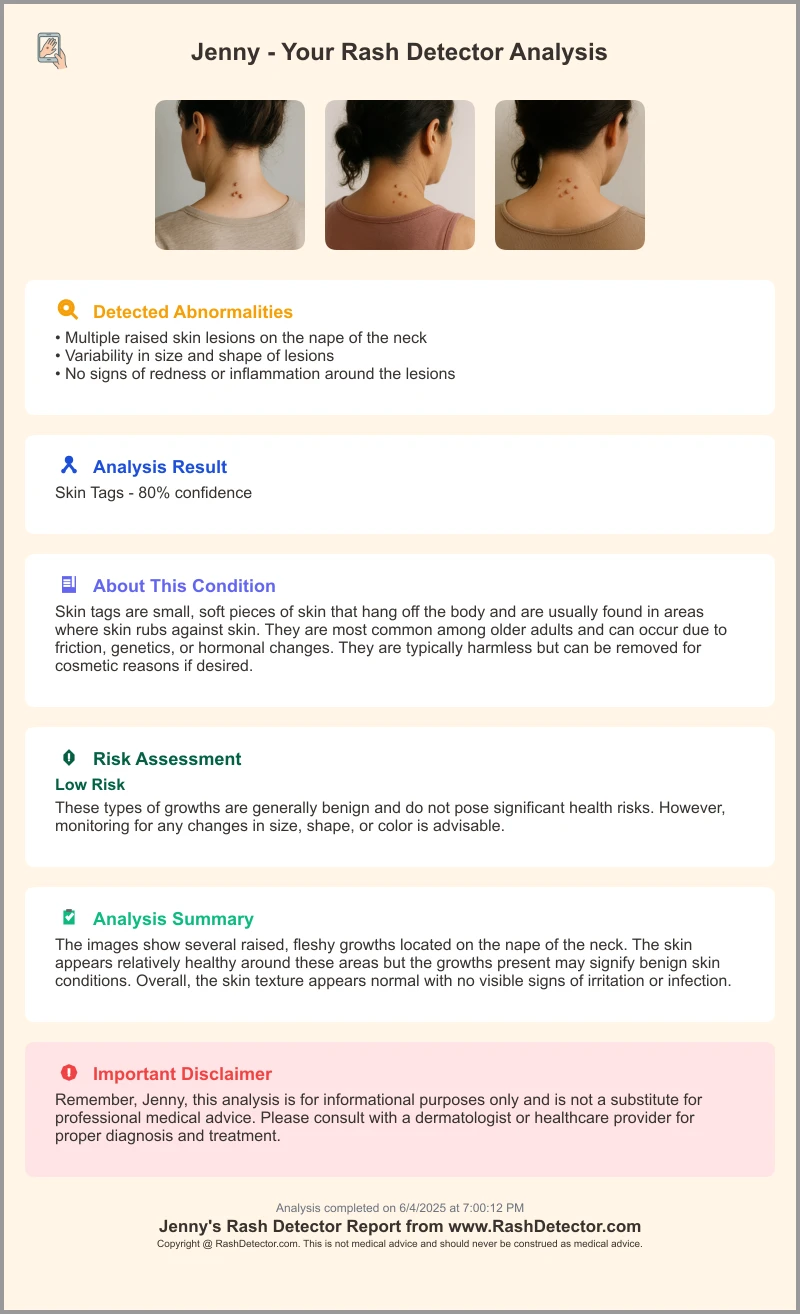
For quick, preliminary monitoring of a suspicious rash, try Rash Detector, an AI skin analysis app that provides instant feedback based on your uploaded photos—here’s a sample report:
5. Treatment Options & Management Strategies
The core of successful medication rash treatment is stopping or switching the offending drug under medical supervision, then easing symptoms.
Over-the-Counter & Home Care
- Antihistamines:
- Cetirizine 10 mg once daily for hives and itch.
- Diphenhydramine 25–50 mg every 6 h (may cause drowsiness).
- Topical Corticosteroids: Hydrocortisone 1% cream twice daily.
- Soothing Measures:
- Cool compresses, 10 min three times daily.
- Colloidal oatmeal baths to relieve itch.
- Loose cotton clothing to minimize friction.
Prescription & Medical Interventions
- Moderate Cases:
- Oral prednisone 0.5–1 mg/kg/day, taper over 2–6 weeks.
- Triamcinolone 0.1% cream for persistent patches.
- Severe Cases:
- Anaphylaxis: Immediate epinephrine IM, airway support.
- SJS/TEN: IV corticosteroids, possible cyclosporine or IVIG; burn-unit care and fluid management.
- DRESS: Extended steroid taper, monitor organ function.
- Adjunctive Options: Compounded calamine or aloe vera lotions.
| Severity | First-Line Treatment | Follow-Up |
|---|---|---|
| Mild | Stop drug, OTC antihistamines, hydrocortisone | Reassess in 3 days; continue if improving |
| Moderate | Oral prednisone, prescription topical creams | Weekly visits; labs if prolonged |
| Severe | Epinephrine, IV corticosteroids, hospitalization | Daily wound care; specialist consult |
6. Prevention & Future Considerations
Pre-Prescription Audits
- Review all current medications and supplements with your doctor.
- Provide a detailed allergy history, including mild prior rashes.
- Ask about lower-risk alternatives if you have past reactions.
Allergy Testing
- Skin Prick Tests: Assess immediate IgE reactions to penicillins and others.
- Patch Tests: Detect delayed reactions to chemotherapy agents or anticonvulsants.
Communication & Monitoring
- Document any reactions clearly in your medical record.
- Wear a medical ID bracelet if you have a severe allergy.
- Monitor for rash during the first 4–14 days after new prescriptions.
- Consider starting high-risk drugs at a low dose with gradual escalation.
FAQ
- What causes a medication rash? A medication rash arises when your immune system reacts adversely to a drug, leading to skin eruptions.
- When should I seek medical help? Visit a doctor if you experience severe itching, rapid spread, blistering, or any red-flag symptoms like swelling of the face or difficulty breathing.
- How are medication rashes diagnosed? Diagnosis involves a detailed drug history, physical exam, blood tests, and sometimes a skin biopsy to determine the reaction type.
- Can medication rashes be prevented? Yes—by sharing a complete allergy history, undergoing allergy testing, and monitoring closely during the first weeks of new drug therapy.
- What treatments are available for severe rashes? Severe cases may require epinephrine, IV corticosteroids, hospitalization, and specialist wound care in a burn unit for SJS/TEN.