Can AI Diagnose All Types of Skin Conditions? Examining AI-Based Rash Detection
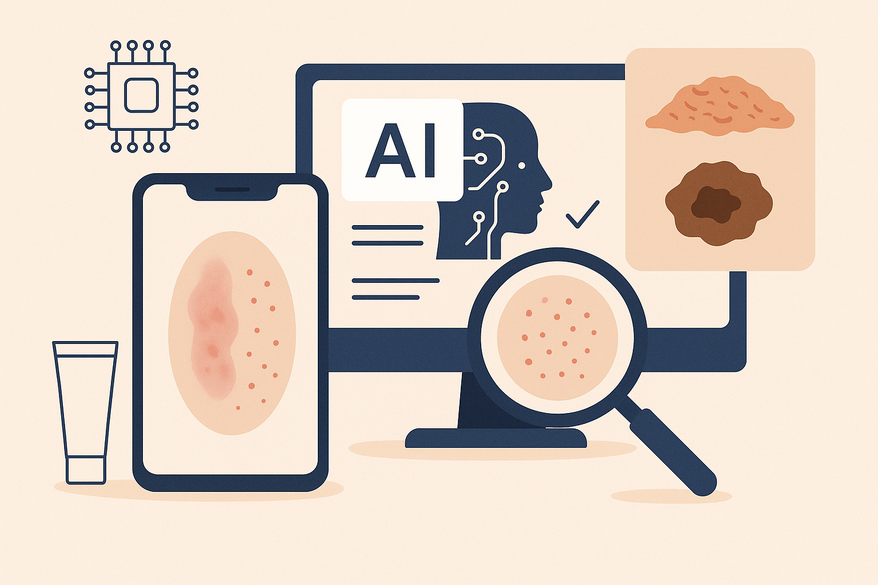
Explore how AI diagnoses skin conditions. Discover its accuracy, limitations, and when to seek expert advice. Can AI diagnose all types of skin conditions?
Estimated reading time: 8 minutes
Key Takeaways
- AI as a powerful screening tool: AI-driven models can rapidly classify skin conditions and flag high-risk lesions, potentially enhancing preliminary assessment.
- Accuracy varies: While AI can sometimes match clinician performance for common conditions like melanoma, it may struggle with rare diseases and diverse skin tones, though recent advances are aiming to improve this.
- Multimodal integration may boost confidence: Combining images with patient history, demographics, and even genomics may improve diagnostic reliability.
- AI augments, not replaces, experts: A hybrid approach—AI triage plus dermatologist evaluation—offers a balance of speed and safety.
- Future prospects: Larger, more diverse datasets, real-time mobile apps, and genomics integration are being developed to make AI dermatology more inclusive and precise in 2026.
Table of Contents
- Overview of AI in Healthcare
- Understanding AI-Based Rash Detection
- Reliability and Accuracy of AI Diagnoses
- Limitations and Challenges of AI Diagnosis
- Real-World Examples and AI Case Studies in Dermatology
- Balancing Technology with Expert Medical Advice
- Future Perspectives on AI in Dermatology
- Conclusion
Introduction
Can AI diagnose all types of skin conditions? This question sits at the heart of modern dermatology and highlights the promise and pitfalls of AI in dermatology. Artificial intelligence (AI) in healthcare refers to computer systems that mimic some aspects of human cognitive functions—such as learning, reasoning, and pattern recognition—to help support the diagnosis and management of diseases. Skin conditions cover a broad range of issues, from common rashes and acne to rare autoimmune disorders and skin cancers.
This question matters because skin diseases affect millions worldwide, and the global rise in cases strains healthcare systems. Patients seek faster, more accessible diagnostics, yet a shortage of dermatologists creates long waiting times and delayed care. In this blog, you will learn how AI-based rash detection works, how accurate and reliable these tools are, what limitations they face, and when you should seek a human expert’s evaluation.
1. Overview of AI in Healthcare
AI in healthcare uses machine learning (ML) and deep learning (DL) to process medical images and structured data. Convolutional neural networks (CNNs) are a form of DL that excel at image recognition. Over time, AI has grown from simple rule-based tools to advanced models trained on large datasets.
- Traditional exam: visual inspection by a dermatologist, biopsy samples, and histopathology review.
- Early computer-aided detection: fixed rules and manual feature extraction.
- Modern AI-driven models: data-driven training on image libraries for pattern recognition. Learn more in Exploring the AI Dermatology Diagnostic Process.
Drivers of AI adoption:
- Dermatologist shortages create long patient wait times.
- Need for rapid triage tools in primary care.
- Desire to reduce unnecessary biopsies and standardize care.
Key benefits:
- Faster preliminary screening of suspicious lesions.
- Consistent, objective assessment across patients.
- Potential to flag high-risk cases for priority review.
2. Understanding AI-Based Rash Detection
AI-based rash detection relies on algorithms that analyze images of the skin. These models learn to recognize patterns linked to specific conditions. Modern AI tools may process multiple image types and data sources for a more comprehensive view.
Input types and modalities:
- Total-body and close-up photographs captured by smartphone or clinical camera.
- Dermoscopic images: magnified views showing skin surface details.
- Digitized histopathology slides for disease pattern analysis.
- Some systems also use short video clips to capture lesion changes in real time.
Common target conditions:
- Skin cancers: melanoma, basal cell carcinoma, squamous cell carcinoma.
- Inflammatory disorders: psoriasis, eczema, seborrheic dermatitis.
- Infectious and pigmentary issues: acne, fungal infections, vitiligo.
- Nail disorders: onychomycosis.
Multimodal integration
Some advanced models combine visual data with patient history, age, symptom duration, and sometimes genomic markers. As of 2026, some platforms are beginning to incorporate patient-reported symptoms (such as itch or pain), family history, and environmental exposures for a more complete assessment.
By using AI-based rash detection, clinicians may be able to rapidly classify rashes and flag urgent cases for dermatology referral. For a technical deep dive into image-processing pipelines and training workflows, see Technical Process of Rash Detection Using AI and Machine Learning.
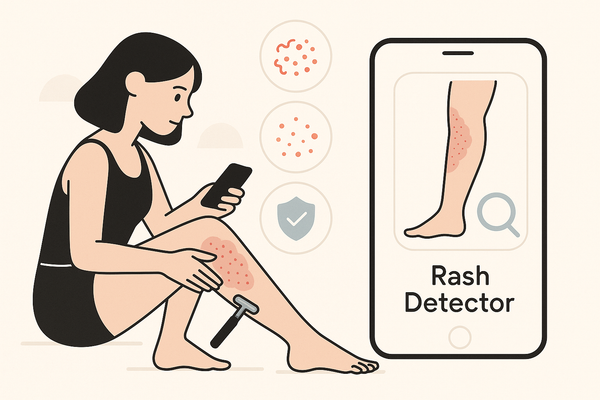
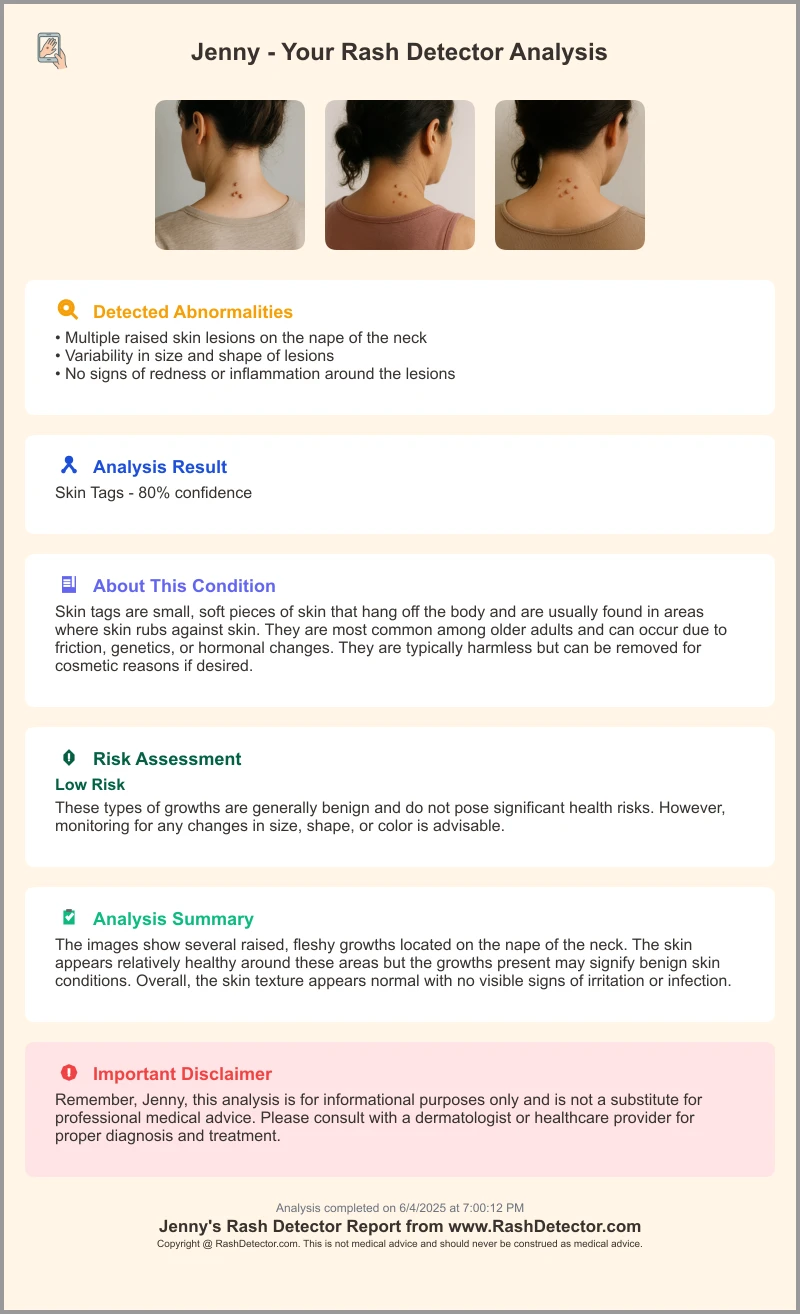
Some consumer tools like Rash Detector (also known as Skin Rash App) let you upload up to three images of your rash to generate an instant analysis report, offering preliminary insights before you consult a professional. As of 2026, the Rash Detector app has expanded support for darker skin tones and now offers optional symptom questionnaires to enhance accuracy.
3. Reliability and Accuracy of AI Diagnoses
Some state-of-the-art AI models have been shown to match clinician performance in certain benchmark tests across a range of skin conditions. However, accuracy varies by disease type, data diversity, and model design.
Factors influencing reliability:
- Training dataset size and diversity – Models trained on large and diverse image sets from varied demographics tend to show better real-world performance. In 2026, several global consortia have expanded datasets to include more images from underrepresented skin tones.
- Algorithm architecture – CNNs with transfer learning, ensemble approaches, and attention mechanisms can improve pattern recognition. Some 2026 models now use transformer-based architectures for greater context awareness.
- Multimodal data integration – Adding clinical notes, patient age, lesion evolution, and genomics may enhance diagnostic confidence.
- Skin tone representation – Imbalanced datasets still pose challenges, but recent tools have aimed to improve accuracy on darker skin by targeted data collection and algorithmic adjustments.
- Condition complexity – Common and well-documented diseases tend to yield higher accuracy than rare or atypical cases.
Reported accuracy benchmarks (2026):
- AI accuracy for melanoma detection has been reported to exceed 90% in some controlled studies, and real-world performance is improving.
- General practitioners typically score 75–85% on similar tasks without AI support, according to some studies.
- For common rashes like eczema or psoriasis, some AI apps report sensitivities and specificities above 85% in validation sets, but performance may be lower for rare or visually similar conditions.
To explore how machine learning specifically enhances skin analysis and overall diagnostic pipelines, check out Machine Learning in Skin Analysis: AI's Role in Diagnosing Rashes and Skin Conditions.
4. Limitations and Challenges of AI Diagnosis
While AI has made impressive strides, it cannot yet fully diagnose all skin conditions equally well. Several hurdles remain before AI tools can safely replace human judgment across the board.
Main challenges as of 2026:
- Data bias and under-representation – While datasets are improving, rare diseases and diverse skin tones can still be underrepresented, leading to blind spots and possible misdiagnoses.
- Overlapping visual features – Conditions like psoriasis, eczema, and seborrheic dermatitis share similar lesions, which can confuse algorithms. Some 2026 models now use sequential image analysis to help differentiate these, but challenges remain.
- Lack of non-visual context – Patient symptoms like itching, pain, or systemic signs are critical to dermatologists but not always captured in image-based AI models. Some apps now include patient questionnaires, but these are not yet standard everywhere.
- Regulatory and privacy hurdles – Compliance with GDPR, HIPAA, and evolving AI-specific regulations in 2026 complicates large-scale image sharing and model deployment.
- Clinical workflow integration – Clinician trust is growing, but AI errors can raise liability concerns and slow adoption. Ongoing education and validation studies are helping address this.
5. Real-World Examples and AI Case Studies in Dermatology
Examining real deployments of AI tools shows both promise and areas for caution.
Case Study 1: PanDerm in Europe (2025–2026)
- Deployment in melanoma referral clinics reportedly reduced time to specialist by 30%.
- Detection sensitivity reportedly improved from 85% to 92% with AI triage.
- Clinician workload dropped, allowing focus on complex cases.
Case Study 2: Community Clinic Trial (2026)
- AI + general practitioner vs. GP alone.
- Combined approach reportedly increased rash diagnostic accuracy from 70% to 88%.
- Patients received faster reassurance or referral, boosting satisfaction.
Counterexample: Rare Connective Tissue Disease (2026)
- AI misclassified a rare skin disease in darker-skinned patients due to lingering under-representation in training data.
- Highlighted need for even more inclusive image libraries and ongoing retraining.
6. Balancing Technology with Expert Medical Advice
AI should support clinical judgment, not replace it. Think of AI as a screening and monitoring tool that can flag concerns for a human expert to review.
- Use AI tools for initial risk assessment and lesion tracking.
- Always consult a board-certified dermatologist for ambiguous, evolving, severe, spreading, painful, or persistent symptoms.
- Treat AI outputs as risk stratification, not definitive diagnoses.
- Seek second opinions for high-stakes conditions like melanoma.
- Verify AI recommendations against clinical findings and patient history.
Important: This information is for general, educational purposes only. For diagnosis and treatment—especially for severe, spreading, painful, or persistent symptoms—see a doctor or dermatologist.
7. Future Perspectives on AI in Dermatology
Research continues to address current AI limitations and expand capabilities.
- Expanding global, multi-ethnic image datasets to reduce bias. As of 2026, several international projects are underway to further diversify training data.
- Integrating genomics and proteomics for precision dermatology—some 2026 platforms now offer optional genomic risk scoring for certain skin cancers.
- Deploying real-time smartphone apps with edge computing for instant, private analysis. Rash Detector and similar apps now process images on-device for improved privacy.
- Evolving regulatory frameworks (FDA, MHRA, and new EU AI Act) to certify AI medical devices and ensure safety.
- Developing continuous learning and federated learning models to protect privacy and improve over time without centralizing sensitive data.
More inclusive, context-aware AI systems could help democratize access to dermatology in underserved regions. Edge computing apps could enable instant self-screening and early referral in remote areas, and integration with telemedicine platforms is becoming more common in 2026.
Conclusion
AI systems have advanced the support of skin disease diagnosis, delivering high accuracy for melanoma and other common conditions in some studies. However, can AI diagnose all types of skin conditions with equal reliability? Not yet. Data biases, lack of context, and rare presentations still challenge AI models. The best approach combines AI for early detection and triage with professional clinical evaluation for complex or atypical cases.
While AI cannot yet diagnose all types of skin conditions definitively, it may be a helpful tool in modern dermatology when used wisely. By relying on both technology and expert medical advice, patients may receive faster care without sacrificing accuracy or safety.
FAQ
- Can AI replace a dermatologist?
Not entirely. AI can assist with screening and triage but lacks the nuanced judgment and context-awareness of a trained dermatologist. - How accurate is AI in detecting skin cancer?
Some state-of-the-art AI models have been reported to exceed 90% accuracy for melanoma detection in controlled studies, and real-world performance continues to improve in 2026. - Does AI work on all skin tones?
AI performance is improving, but models may still underperform on some skin tones if not specifically trained on diverse data. Leading tools in 2026 are addressing this gap. - When should I trust AI results?
Use AI for preliminary assessment. Always follow up with a clinical exam for any suspicious, severe, spreading, painful, or persistent lesion. - What are future improvements for AI in dermatology?
Expect more inclusive datasets, genomics integration, and real-time mobile analysis for broader, safer adoption as we move further into 2026 and beyond.